
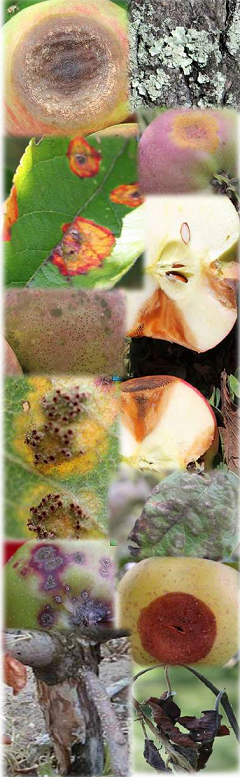
Collar rot ( Phytophthora cactorum )

1. Introduction
2. Symptoms

• Phytophthora collar rot attacks the lower 30 inches (76 cm) of apple trunks.
• Most infections start at the junction of a lateral root with the trunk.
• Infected bark becomes brown and is often soft and mushy or slimy when wet.
• Dark streaks often occur near the cambium and extend beyond the canker margin. If a canker enlarges for several years, only the marginal areas show the typical color and texture of newly killed tissue.
• The development of the canker is rapid, horizontally and vertically. The ultimate effect of collar rot is to girdle the affected limb, roots, or trunk, resulting in the death of that organ or of the entire tree.
3. Damage caused

The disease causes a severe damage to the terminal growth of the foliage and fruits.
4. Confused with
5. Disease cycle

6. Pathogen biology
7. Management
Cultural Practices:
I. Clean the infected collar area with a sharp edged knife and apply Chaubattia paint (Copper carbonate + red lead + linseed oil in the proportion of 1:1:1.25) or Bordeaux paste (copper sulphate + lime + linseed oil in the proportion of 1:2:3).
ii. Improve drainage around the tree basin.
Chemical Control
Drench the soil under tree canopy with Metalaxyl MZ 72WP @ 0.5% or Mancozeb 75 WP @ 0.6% or Copper oxy-chloride 50 WP @ 0.6%. Repeat drenching after 15-20 days after first drenching.


Conceptualized, Designed and Developed by Shabir Ahmad Mir, Sr. Computer Programmer, KVK (Farm Science Centre), Kulgam, Kashmir.
EVALUATION & VALIDATION COMITTEE