
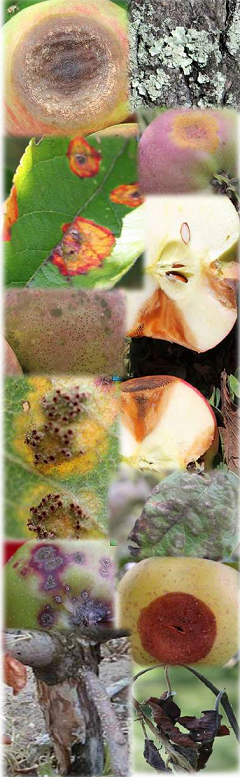
Marssonina leaf blotch ( Marssonina coronaria )

1. Introduction
2. Symptoms

• The disease symptoms appears in form of dark green circular patches on upper surface of leaf giving rise to 5-10 mm brown leaf spots which become dark brown in due course.
• On maturity it also develops on lower surface of the leaf.
• Small black acervuli are visible on the surface of leaf.
• When lesions are numerous, they coalesce and to form large dark brown blotches and the surrounding areas turn yellow.
3. Damage caused

The disease appears as dark green areas interspersed with lighter or yellow portions on the mature leaves giving a mosaic like appearance, followed by brown to dark brown lesions of varying size ranging from 5 to 10 mm in diameter. As the disease advances, the infected leaves turn yellow and fall early in the season. In excessively humid conditions, the lower portion of the tree is defoliated within few weeks and only fruits are seen hanging on the naked branches.
Dark coloured pin-point specks are visible in and around the diseased leaf area. Fruit symptoms although not observed in Kashmir, are characterized by the appearance of 4-5 mm circular to oval brown spots which later become depressed and turn dark brown to black in color.
4. Confused with
5. Disease cycle

6. Pathogen biology
7. Management
Cultural practices:
I. Ensure collection and destruction of fallen leaves, mummified fruits, pruned snag and dead wood.
ii. Remove crowded branches for proper aeration and sunlight to avoid high humid conditions in orchard micro-climate.
iii. Remove the disease twigs/branches at least 6 cm below the point of visible infection and apply wound dressers like Chaubattia or Bordeaux paste at the end cuts.
iv. Keep orchard floor clean from weeds, wild plants to avoid excessive humid condition in the rainy season. Ensure proper irrigation during hot dry periods to avoid tree stress.
v. Remove dormant shoot tip and silvered twigs to reduce source of primary infection in powdery mildew.
vi. Fruits in clusters provide favourable micro-climate for sooty blotch and flyspeck spread. Thinning of such fruits is important in reducing the disease incidence.
vii. Maintain low mite population to avoid Alternaria blotch (A.mali) outbreak.
Chemical Control
Use fungicides as per the Spray Schedule


Conceptualized, Designed and Developed by Shabir Ahmad Mir, Sr. Computer Programmer, KVK (Farm Science Centre), Kulgam, Kashmir.
EVALUATION & VALIDATION COMITTEE