
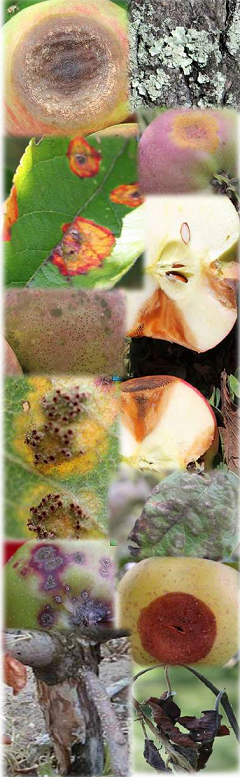
Root rot ( Dematophora necatrix )

1. Introduction
One of the most serious diseases that infects apples is Root rot. This disease is caused by several species of Phytophthora. Root rot occurs when the fungus attacks roots away from the crown area. These diseases may occur simultaneously, in any combination, or singly depending on the portion of the tree that is attacked.
2. Symptoms

• Infection can occur on large roots or at the tree collar.
• In fruit trees, the base of the trunk at soil level can show signs of a dark, wet rot, especially if kept moist by weeds or wet weather.
• As the disease progresses, the infected tissue becomes rotten.
• Trees develop a generally unthrifty appearance with leaf yellowing, cessation of root growth, small leaves, premature leaf fall and small, shriveled fruit. Infected trees will eventually die.
3. Damage caused

4. Confused with
Collar rot and Crown rot
5. Disease cycle

6. Pathogen biology
7. Management
Water management is the key to controlling diseases caused by Phytophthora spp. Do not allow water to accumulate around trees crowns. Provide adequate drainage, and avoid planting in heavy soils, low spots, and areas that flood frequently. Once Phytophthora is established in an orchard, it is impossible to eradicate. Therefore, replanting where trees have died from this disease is risky. If trees are replanted in diseased areas, plant them on raised mounds or on broad ridges so that the upper roots are near the soil surface. Always plant with the graft union well above the soil line.


Conceptualized, Designed and Developed by Shabir Ahmad Mir, Sr. Computer Programmer, KVK (Farm Science Centre), Kulgam, Kashmir.
EVALUATION & VALIDATION COMITTEE