
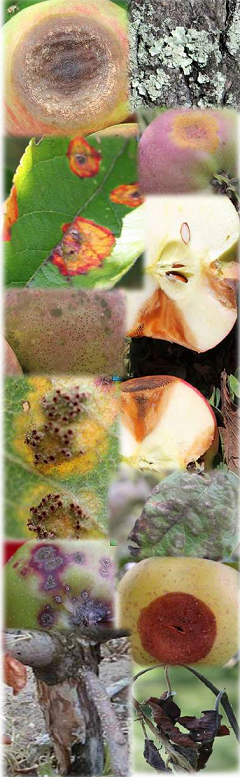
Scab ( Venturia inaequalis )

1. Introduction
Superficial, velvety dark-olive-to-black spots on fruits and leaves are the initial symptoms of apple scab. These fruit spots become scab like with age and tissues may become misshapen. The fungus survives in dead leaves on the ground. Primary spores are discharged during spring rains and infect young leaves and fruits during prolonged moisture. Secondary spores may spread disease from established infections on trees. As a rule, this disease requires yearly treatments. As plant parts mature and the weather gets warmer, susceptibility to this disease decreases, but pinpoint scab can occur during extended periods of moisture during summer.
2. Symptoms

• The disease usually noticed on leaves and fruits.
• Affected leaves become twisted or puckered and have black, circular spots on their upper surface.
• On the under surface of leaves, the spots are velvety and may coalesce to cover the whole leaf surface. Severely affected leaves may turn yellow and drop.
• Scab can also infect flower stems and cause flowers to drop.
• The lesions later become sunken and brown and may have spores around their margins
• Infected fruit become distorted and may crack, allowing entry of secondary organisms.
3. Damage caused

Severe damage on fruits and plant
4. Confused with
5. Disease cycle

6. Pathogen biology
7. Management
Cultural control:• Clean cultivation, collection and destruction of fallen leaves and pruned materials in winter to prevent the sexual cycle.• Collect and burn the infected plant debris. • Follow proper trimming and pruning of twigs and branches followed by burning.• Apply urea (2 Kg/acre at pre-leaf fall stage spring and dolomitic lime (2.5 ton/acre) in autumn over fallen leaves to accelerate decomposition.
Chemical control:
• Spray bitertanol 25% WP @ 0.75 g/l of water and use spray fluid of 10 l/tree or captan 50% WP @ 1000 g in 300-400 l of water/acre or captan 75% WP @ 666.8 g/ acre in water required to distribute 10-20 l/tree or carbendazim 50% WP @ 1000 g/acre and 10 l spray fluid/tree or chlorothalonil 75% WP@ 200 g in 100 l of water and 10 l of spray fluid/tree (recommended for use immediately after dormancy up to greentip stage) or difenaconazole 25 EC @ 15 ml in 100 l of water (spray volume depending upon the tree size and spray equipment used) or dithianon 75% WP @ 720 g in 920 l of water/acre or dodine 65% WP @ 0.75 g/l and use spray fluid of 10 l of spray fluid/tree or fenarimol 12% EC @ 40 ml in 100 l of water and 10 l of spray fluid/tree or flusilazole 40% EC @ 0.1 ml/l of water and 10 l of spray fluid/acre or hexaconazole 5% EC @ 50 ml/100 l of water (spray volume depending upon the tree size and spray equipment used) or mancozeb 75% WG @ 3 g/l of water and use spray fluid of 10 l/tree or myclobutanil 10% WP @ 0.4 ml/l of water and use spray fluid of 10 l/tree or penconazole 10% EC @ 50 ml in 100 l of water and 10 l of spray fluid/tree or sulphur 80% WG @ 750-1000 g in 300-400 l of water/acre or thiophanate methyl 70% WP @ 286 g in 300-400 l of water/acre or zineb 75% WP @ 600-800 g in 300-400 l of water/acre or ziram 80% WP @ 600-800 g in 300-400 l of water/acre


Conceptualized, Designed and Developed by Shabir Ahmad Mir, Sr. Computer Programmer, KVK (Farm Science Centre), Kulgam, Kashmir.
EVALUATION & VALIDATION COMITTEE