
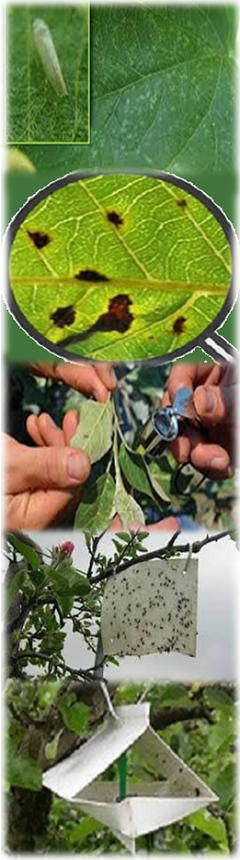
Scouting

Systematic monitoring of pest populations, weather conditions, plant health and disease symptoms are critical components of an IPM decision making, regardless of the control strategies used. Scouting provides an objective summary of the crop condition and pest situation in a field. Every season should begin with the recording of vital field information on soil fertility and crop inputs. This information, combined with regular scouting, accurate identification and diagnosis of problems and a record of those observations, makes for a successful crop monitoring program. By regular monitoring, a scout is able to gather current information on the identity and location of pest problems and to evaluate treatment effectiveness. The following are the basics of scouting programs which needs to be followed for Apple IPM Programs.

1. Know and Identify Your Enemies

Distinguish between pests, beneficial organisms, and incidental or innocuous organisms. Identify damage and possible culprits. Know when (season, plant life cycle) damage is likely to occur

2. Monitoring

. Monitor at least once a week during critical stages.
. Monitor at approximately the same time each day.
. Inspect plants to get an accurate idea of pest pressure.
. Look for patterns, patches, areas of poor plant growth and/or colour.
. Examine fruit clusters, underside of leaves, inside the canopy, etc.
. Scout the edges of the field and interior of the field separately.
. Give special attention to border areas.

3. Procedure

. Use spray schedules to know when certain pests will be active.
. Learn to identify symptoms and damage caused by diseases & pests.
. Understand the biology and life cycle of pests and diseases.
. Recognize beneficial insects, as well as harmless insects.
. Use historical data to identify hot spots and previous problems.
. Keep a field map and record the location of damage.
. Record the stage of crop development, disease severity, population
.levels of insect pests and beneficials, and damage observed.
. Keep a log of rainfall amounts, daily high and low temperature.
. Keep a record of pesticides applied and other control measures used.

4. Economic Threshold/Action Guidelines

a. Decide whether action is needed
b. Use numerical threshold for insects and mites
c. Decide how much damage you can tolerate
d. A treatment threshold specifies pest density at which control
measures need to be applied to prevent loss of crop value

Conceptualized, Designed and Developed by Shabir Ahmad Mir, Sr. Computer Programmer, KVK (Farm Science Centre), Kulgam, Kashmir.
EVALUATION & VALIDATION COMITTEESCIENTIFIC RESOURCE & CONTENT PROVIDERSDECLAIMER